Showing posts with label Jingjin. Show all posts

Monday, June 19, 2023

Movement Organized by the Channel Sinews

Channels and Movement Organization

The Channels Organize Movement

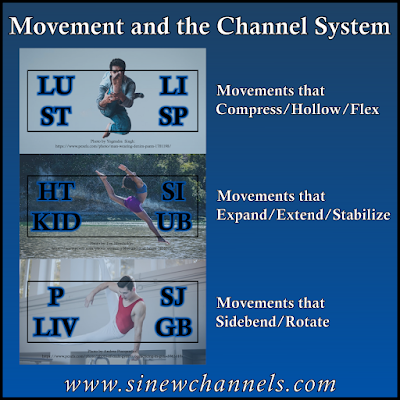
If you are an acupuncturist, then you learned a portion of the above image. You learned this as the circadian cycle where energy is at is peak during a 24 hour time period. You also learned various channel correspondences. For instance, the following are internally-externally related channels: LU-LI, ST-SP, HT-SI, KID-UB, P-SJ, LIV-GB. And, finally, you learned the following six divisions: Taiyang (UB-SI), Shaoyang (GB-SJ), Yangming (ST-LI), Taiyin (SP-LU), Shaoyin (KID, HT), Jueyin (LIV-P). You already know that the channels in each of the 3 grouping above share many relationships.  

What you have not been taught, at least in a Chinese Medical Curriculum, is that movement is integrated around these 3 groupings. To fully understand this, you need to dive into the sinew channels (jingjin) and this is exactly what I have been exploring for the last 20+ years. This started with my interested in movement (taiji, qigong, bodyweight calisthenics), developed with my interest in fascial systems such as Anatomy Trains, and continued with exploration on approximately 100 cadaver dissections. This has led to the development of a comprehensive sinew channel model that is taught in the Sports Medicine Acupuncture Certification program where I am a faculty member.

This past Spring 2023, I presented on channels and movement at the first annual Pacific Sports and Orthopedic Acupuncture Symposium (PSOAS). The info below is a summary of this presentation and work I am continuing to develop.

The Channel Sinew Groupings & Functional Movement Patterns

While you can explore what an individual sinew channel does in terms of movement, there is greater benefit in understanding that functional movement patterns are organized by the groupings above. Most movements, especially full body movements  are too complex to analyze with a single channel. Take, for instance, something relatively simple such as a pull up. This movement engages many muscles of the back and involves the UB sinew channel. But the external shoulder rotators are also engaged which would be part of the SI sinew channel. And, if your form is good, there is engagement of core structures such as the transverse abdominis, part of the KID sinew channel. This relatively straightforward movement primarily involves expansive movements that lift and propel the body forward. These movements lift the body up (literally, in the image below), but also lift you into an upright posture, and they also stabilize the spine. They are controlled by the Taiyang and Shaoyin channel sinews.


Expansive movements of the Taiyang-Shaoyin channel sinews
Photo by Ruslan Khmelevsky: https://www.pexels.com/photo/muscular-sportsman-doing-pull-up-exercise-in-gym-4608157/

Other movement patterns guided by the Yangming-Shaoyin channels compress and hollow the body. They protract the scapulae, depress the chest, and flex the torso and hip. Hollow body holds, L-sits, a front kick, and many other movements fall into this category. These movements balance the expansive ones described above and there are many exercises that move back and forth between these two groupings. For instance, rowers would move back and forth between these phases; going into a compression so that they have more range as they engage the back, expand and propel forward as they pull the paddle through the water. You have to compress and load the spring before you expand, especially if you want to do it explosively. The spinal wave from White Crane qigong is another example of this ebb and flow and you can watch my video by clicking here. 

Compressive movements of the Yangming-Taiyin channels
Photo by Andrea Piacquadio: https://www.pexels.com/photo/photo-of-male-gymnast-practicing-on-gymnastic-rings-3763702/

The final grouping involves the Shaoyang and Jueyin channels which execute two very related movement patterns; sidebending and rotation. This involves trunk and neck sidebending, but also abduction and adduction of the limbs, along with rotational movements. A very simple example is in a video below where I am swinging on monkey bars. This exercise illustrates both rotation, but you will also see sidebending if you watch the video; all engagements of the Shaoyang and Jueyin channels. Note: I mention the Gallbladder sinew channel in this video, but all of the channels in this category are involved. I was simplifying since it is hard to describe these types of concepts in a video without being distracting.

Rotational and Sidebending movements of the Shaoyang-Jueyin channels
Photo by Los Muertos Crew: https://www.pexels.com/photo/woman-doing-sports-at-sports-hall-10039561/

Check out my Youtube channel where I will be exploring many of these concepts. If you do visit, especially if you find the information useful, please subscribe, like the videos, and comment on the videos. All of this helps build my channel and allows me to put the time into producing more content. Besides this, I appreciate the comments since it helps be continue to organize this information and we can all learn together!


Facebook icon Google Search icon LinkedIn icon Instagram icon YouTube icon

Tuesday, May 5, 2020

Medical Qigong - May Schedule

Email brian@ideal-balance.net for the Zoom Meeting ID and password
See below for class schedule and class descriptions

Class Schedule for May
Monday
Tue
Wednesday
Thursday
Friday
Saturday
Sun
Eight Pieces of Brocade (F)
9:30-10:15am est
Eight Pieces of Brocade (F)
9:30-10:15am est
Five Animal Sports 
(SG) 9:30-10:30am est
Eight Pieces of Brocade (F)
9:30-10:15am est
Five Animal Sports Practice (F)
10:30-11:30 am est

Medical Qigong for Acupuncturists
(MQA) $30
12:00-1:00 pm est

Low Back & Hip 
(SG) $20
2:00-3:00pm est
Neck & Shoulder (SG) $20
2:00-3:00pm est


Classes may be added for May. Check back and refresh the page to see updated schedule

F – Free; classes are follow-along. Group instruction is given, but not individual, due to group size and class structure. Donations are welcome but not required. Participants can use the Paypal donation link below (paypal account needed) or send an email and we can invoice you via Square. 


SG – Small Group; limited to 5 participants. Sign up beforehand by email to brian@ideal-balance.net; an email address is necessary to register. Instructor can see participants and will give individual instruction. Classes include qigong and other corrective exercises to improve strength, flexibility and function and overall health and wellness. Classes are $20 (invoiced via Square; do not use the donation link).


MQA – Medical Qigong (for Acupuncturists); limited to 5 participants. Sign up beforehand by email or phone; an email address is necessary. Instructor can see participants and will give individual instruction. Class will include active qigong instruction and integrated discussion of acupuncture points, channel sinews (jingjin) and zangfu and how these relate to the movements. Classes are $30 (invoiced; do not use the donation link).


T – Telemedicine (by appointment). Private one-on-one session. A telemedicine appointment is private and HIPAA-compliant and a detailed history and assessment is performed. A detailed treatment is given which can include self acupressure and massage (sometimes with tools such as a foam roll or therapy balls), specific corrective exercises prescriptions, core stabilization exercises, herbal medical prescriptions. Call or email to request an appointment.


Class Descriptions

Eight Pieces of Brocade: This sequence includes 8 moves, done individually, each working on a specific organ system. This form is very accessible and easy to learn, does not require difficult stepping or shifting of weight and can even be done seated.  
Five Animal Sports: This sequence includes 5 moves that are part of each "Animal" (25 moves total). Each Animal represents an organ that is being worked on from the point of view of Chinese physiology. This form is a bit more challenging and does involve stepping and shifting, but can be modified to meet individual needs and can be done seated if necessary. This form is very dynamic and a lot of fun!

Strengthening for Qigong: Effective qigong practice requires physical strength, especially in key areas. This class will focus on strengthening the core, the neck and shoulder muscles, the arches of the feet, and the legs, hip and gluteal muscles — all areas that can become weak and lead to poor posture, a compressed spine and poor circulation in the internal organs.
Recommended: an exercise mat and folding chair (or other chair or stool) is suggested, as some exercises will be done seated or lying down.

Low Back & Hip: This class is excellent for managing low back and hip conditions and features diverse qigong and corrective exercises to increase flexibility, balance pelvic alignment, and strengthen the core and important structures for low back and hip stability. 
This class is good for both prevention and for general conditions, but for more severe pain, the telemedicine sessions might be indicated.
Recommended: Loose fitting clothing, mat, folding chair (or other chair or stool)

Shoulder & Neck: This class is excellent for managing neck and shoulder pain, headaches, and jaw tension. It features diverse qigong and corrective exercises to increase flexibility, re-align the neck, shoulder and head, and strengthen the core and important structures for neck and shoulder stability. 
This class is good for both prevention and for general conditions, but for more severe pain, the telemedicine sessions might be indicated.
Recommended: Loose fitting clothing, mat, folding chair (or other chair or stool)

Knee, Ankle & Foot: This class excellent for managing knee, foot or ankle pain. It features diverse qigong and corrective exercises to increase flexibility, properly align the foot/knee/pelvis structure, and increase strength for stability in standing and walking. 

This class is good for both prevention and for general conditions, but for more severe pain, the telemedicine sessions might be indicated.
Recommended: Loose fitting clothing, mat, folding chair (or other chair or stool)

Medical Qigong for Acupuncturists: This class for healthcare professionals will explore from an in-depth clinical perspective how the movements massage/mobilize certain acupuncture points and regions, engage the channel sinews (jingjin), and massage/mobilize the internal organs (zangfu). Students will work with multiple qigong sets such as the Eight Pieces of Brocade and Five Animal Sports, to improve their own health and understanding, and to learn effective strategies for working with patients.


Facebook icon Google Search icon LinkedIn icon Instagram icon YouTube icon

Sunday, November 18, 2018

Sports Medicine Acupuncture® Fall 2018

Flexor carpi ulnaris manual muscle test,
a useful test for medial epicondylitis.
I have had a very busy Fall, and have not been able to post here lately. However, I did just finish a blog post for the Sports Medicine Acupuncture® blog. The link is below; the post includes a video of a recent Sports Medicine Acupuncture dissection highlighting the Heart sinew channel. Check it out! The title is Medial Epicondylitis and the Heart Channel Sinews.

September kicked off Module 2 of the Sports Medicine Acupuncture Certification (SMAC) in San Diego, CA. Updates and upgrades are an ongoing feature of the SMAC program, and in this Module we debuted a new class: "Assessment and Treatment of the Channel Sinews (Jingjin): Low Back, Hip and Groin." I will share some info from this class in an upcoming blog post and  the upcoming classes for the Lower Extremities (Module 3) and Head, Neck & Upper Extremities (Module 4).

A picture I took with four practitioners who live near me in Tampa, FL. It is alwasy great to meet new people in SMAC, but is especially an honor to work with practitioners who I am already friends with!


After the September SMAC class, Sports Medicine Acupuncture® hosted a 5-day dissection class in Boulder, CO at the Laboratories of Anatomical Enlightenment. In this 5-day class, participants, including myself, worked in teams of 6, each with their own cadaver specimen. As in all Sports Medicine Acupuncture dissections, these specimens are non-chemically treated cadavers, which offers a superior experience for holistic practice as it keeps the fascia intact and you get a much better view of the real tissue quality. All acupuncturists should take the opportunity to do dissection such as this; there really is no substitute for it. I will share some specific experiences from this event soon, and we will be hosting another program, probably a 4-day, sometime in the Spring. Check the SMA page for updates.

After the Boulder dissection class, it was back to San Diego for the completion of SMAC Module 2: Low Back, Hip and Groin. The two remaining classes were Assessment and Treatment of Low Back, Hip and Groin injuries, and Postural Assessment and Corrective Exercises (PACE).That wraps it up for Module 2, and we will start back up with Module 3 in the new year.

In the first week of November, I attended a 5-day taiji and qigong workshop at the new International center of the Taoist Tai Chi Society. I won't go into detail about this workshop here, but I will say that my taiji and qigong practice (which I started in 1998) was the first experience I had with the channel sinews. In my practice, we discuss certain 'tendon changing and marrow-washing' exercises. These 'tendons' may run all the way up the body. Obviously, these are not what Western anatomists refer to as tendons, but are, instead, myofascial planes of tissue that fit the template of how I discuss the channel sinews. This practice was the foundation which led to my ongoing exploration of the channel sinews.

Finally, on November 14th, I was privileged to be a guest on the terrific podcast, "Qiological", hosted by Michael Max. This was a panel discussion on myofascial trigger points, orthopedic acupuncture, and dry needling; but also on channel theory, language, and continual learning. The panel included Michael Max, my friends and colleagues Josh Lerner and Fernando Bernall, and myself. This was a fascinating discussion and I am looking forward to its release on Qiological. It will likely be released early for subscribers. I recommend subscribing, not just to listen early, but as a great way to support the efforts that build and grow our profession; this podcast and its growing community are part of those fantastic resources!

Facebook icon Google Search icon LinkedIn icon Instagram icon YouTube icon

Saturday, April 7, 2018

Injection and the Sinew Channels

Tomorrow I am a guest instructor with Christina Captain's excellent injection certification in Sarasota, FL. I have taught this class for several years. Below is a description of what I will be teaching, and what my philosophy is when using injection and when teaching.

First, I think that it is fantastic that some states have injection in the scope of practice for acupuncturists, as Florida does. It is a worthwhile endeavor for the state professional organizations to work towards expanding the scope to include injections in the states that do not have this. However, I don't think that acupuncture physicians should get too allopathic when using injection. We have this wonderful and extremely advanced channel system that is easy to lose sight of when we are all of a sudden using a hypodermic needle, especially when treating musculoskeletal pain and injury.

When I teach as part of this injection certification in Florida, I am there as a guest instructor from the Sports Medicine Acupuncture Certification program (SMAC). As a guest instructor, I am teaching injection for musculoskeletal pain, sports injuries, and other orthopedic conditions. So, much of what I teach is very influenced by what is taught in SMAC.

In SMAC, we do not teach injection. Very few states have this in the scope of practice and this is an international program. We teach how to assess and treat orthopedic conditions and how to integrate these treatments with Traditional Chinese Medicine (TCM) to build a comprehensive treatment protocol. These treatments build on what acupuncturists already know. For instance, is this an excess or deficient pattern? Does the person have Blood deficiency, Spleen Qi deficiency and Dampness, Kidney Yin deficiency? All of the elements that make our medicine so powerful are included and highlighted. Added to this is a comprehensive ability to assess specific musculoskeletal injuries while understand the muscle imbalances that contribute to these injuries. This means that we teach how to diagnose the specific injury and assess the imbalances in the sinew channel (jingjin) that contribute to the injury and prevent proper healing.

Treatments include the following local, adjacent and distal approach:
  1. Specific, advanced needle techniques for the condition.
  2. Treatment to balance the sinew channels which entails balancing overactive (excess) muscles  and inhibited (deficient) muscles. This includes acupuncture to the motor points of the muscles involved and to distal points along the channel that these muscles are a part of.
  3. Myofascial release techniques to support the treatment and increase the therapeutic outcome.
  4. Prescription of corrective exercises to support the treatment and correct muscle imbalances and postural disparities. 
In my mind, nothing changes when using injection. I can use injection as part of the local treatment. Often, I will be using the same local, injury specific technique. These techniques were developed by the founder of SMAC, Matt Callison, and are extremely effective with an acupuncture needle and can easily be adapted for injection. Added to this will be placing a homeopathic injectable solution (I use Heel products such as Traumeel and Zeel) at the site of injury which, depending on the injectable,  can help reduce inflammation, reduce irritation of a joint, nerve or muscle, and stimulate lymphatic circulation.

However, I still want to use acupuncture, myofascial release techniques and corrective exercises to balance the sinew channels and I still want to treat any zangfu imbalances that present with the patient. What I do not want to do, and what I want to encourage acupuncturists adding injection to their treatments not to do, is simply to inject the local tissue that is affected and lose sight of the comprehensive, holistic, and advanced nature of our medicine.


Facebook icon Google Search icon LinkedIn icon Instagram icon YouTube icon

Sunday, August 21, 2016

The Gluteus Maximus and Converging Sinew Channels


Fig. 1: Image from Functional Atlas of the Human
Fascial System by Carla Stecco
This image (Fig. 1)  is from the excellent book, Functional Atlas of the Human Fascial System, by Carla Stecco. In Manhattan two years ago, during the Sports Medicine Acupuncture Certification (SMAC) program, Matt Callison and I were preparing a fresh tissue cadaver specimen for the Anatomy/Palpation/Cadaver lab for Module 3, which addresses the lower back and hip. In this specimen, we observed an interesting fascial expansion which extended from the deep fibers of the gluteus maximus and connected to the hamstrings and sacrotuberous ligament (STL). This was in the region of BL-36. We saw this as confirmation that the gluteus maximus was part of the Urinary Bladder sinew channel.

Fig. 2: Image from
A Manual of Acupuncture
by Peter Deadman
Maybe this seems like an obvious sinew channel in which to place this muscle, but consider that the gluteus maximus also attaches to the iliotibial band (ITB) which is on the lateral leg. Also, this muscle matches the topography described in the Lingshu, which mentions that the Gallbladder sinew channel has a branch that attaches to the sacrum (Fig. 2 and 3). Both of these vectors of pull are discussed in Stecco's book and seen in Fig. 1. The black line (ITB - gluteus maximus - sacrum) describes the GB sinew channel. The red line (hamstrings - gluteus maximus - STL - thoracolumbar fascia and erector spinae) describes the BL sinew channel. So, the gluteus maximus is an example of where two sinew channels converge. Like the primary channels, this kind of convergence is something that occurs with some regularity.


Fig. 3: Image from
An Atlas of Human
Anatomy for
Students and
Physicians by
Carl Toldt
A few clinically useful things can be taken from this:

1) The gluteus maximus MP can be added to treatments that affect the GB sinew channel. These include trochanteric bursitis, iliotibial band friction syndrome, and asymmetrical pelvic tilts (contributing to a host of potential problems). Treatment can include GB distal points.

2) The gluteus maximus MP can be added to treatments that affect the BL sinew channel. These include hamstring and gluteus maximus strain, hamstring tendinopathy, coccydynia, sacroiliac joint problems, and erector spinae strain. Treatment can include BL distal points. 

3) The gluteus maximus MP has an empirical use, which is that it reduces tension in the upper cervical muscles. This is an example of treating below to affect above on the same channel. 

4) The gluteus maximus MP can be considered as a distal point when treating restriction and pain in the pectoralis muscle. The pectoralis major is on the Heart sinew channel, so this can be considered a midday-midnight (GB-HE) treatment. And, there is a branch of the BL sinew channel which also travels through the pectoralis major via the  thoracolumbar fascia - latissimus dorsi - pectoralis major - SCM branch seen in Fig 4. It is not imperative that you know which channel relationship you are affecting, and this topic can be taken up another time. 

5) Lastly, the gluteus maximus becomes bilaterally weak when there are upper cervical vertebral fixations. This is harder to explain easily; I can refer you to an article I wrote that was in the Illinois Association of Acupuncture and Oriental Medicine Newsletter (The Illinois Acupuncturist) and will be in the upcoming Florida State Oriental Medical Association newsletter. This is also posted on my blog and you can click here to see it. 

Basically, I see this problem as an interaction of the Urinary Bladder sinew channel and the Spleen and Stomach sinew channels, and an example of Earth overacting on Water. These sinew channels have an agonist/antagonist relationship. The Stomach and Spleen sinew channels become bound, which restricts the anterior portion of the diaphragm and the deep anterior myofascia (abdominals below, transversus thoracic and hyoids above). This causes tension in key regions of the spine and can lead to vertebral fixations. Certain muscles on the BL sinew channel then become bilaterally weak (the gluteus maximus in the case of upper cervical fixations). In Sports Medicine Acupuncture, we treat upper cervical fixations by using vertebral mobilization techniques for the affected vertebrae, needling SP-4/P-6 (which affects the deep holding pattern) and needling the MP of the gluteus maximus. 

Fig. 4: Image from A Manual of Acupuncture by Peter Deadman


Facebook icon Google Search icon LinkedIn icon Instagram icon YouTube icon

Sunday, April 10, 2016

Acupuncture Treatment for the Spiral Line

A common treatment we utilize in Sports Medicine Acupuncture® when there is strain along a sinew channel involves the classical needle technique of multiple needles along a line (pai ci). This treatment can help release bound fascia and restore length and range of motion along this line. This post will discuss an acupuncture treatment for shortening along the upper portion of the spiral line (SPL) discussed in Anatomy Trains; it is a useful protocol for posterior neck pain (often unilateral) when there are shifts and rotations seen between the pelvis, ribcage, and neck.

The SPL is a myofascial structure that winds around the body. Posturally, it can be be associated with rotational distortions and shifts of major body structures. Often times, it is involved with more superficial counter rotations to deeper core rotational patterns, such as those caused by having one psoas shorter than the other.

First, a word about what the SPL is and how it relates to the sinew channels. The SPL is a myofascial meridian discussed in Thomas Myers' book Anatomy Trains: Myofascial Meridians for Manual and Movement Therapists. There are strong parallels between the sinew channels discussed in Chinese medicine and the Anatomy Trains (myofasical meridians) discussed by Myers. I have used this book, along with other sources, as one of my references as I determine which myofascial (muscles and fascia) structures belong in which channel. This sinew channel information is then taught in the Sports Medicine Acupuncture Certification program (which, for this certification cycle, is in Chicago).

While there are points in common, there are also key differences between which structures make up the sinew channels and which are discussed in Anatomy Trains. The spiral line, however, is not similar to any one sinew channel, and can be seen as a unique structure. Actually, it involves the interaction of multiple sinew channels, primarily the Urinary Bladder, Gall Bladder, and Stomach sinew channels.

The upper SPL travels from the ASIS of one ilium, crosses to the opposite ribcage, wraps around to the posterior torso and travels under the scapula, and crosses back around to the other side at the spine (on the same side as it started) to connect to the neck. For instance, if we started at the left ASIS, it would incorporate the left internal oblique muscle, the right external oblique to the right serratus anterior, and right rhomboids (see the last post on the rhombo-serratus sling), then crossing over to the left splenius cervicis and splenius capitis to attach at the left transverse processes of C1-C3 and head. There would be a parallel structure on the opposite side of the body starting at the right ASIS and ending on the right C1-C3 transverse processes.

When there is shortness in one SPL, the ASIS will be closer to the contralateral lower ribcage. This will be seen with a ribcage that is shifted left or right in relation to the pelvis (shifted towards the ASIS of the short SPL) and/or rotated in relation to the pelvis (rotated toward the ASIS of the short SPL). This will be caused by shortness in the fascial sling of one internal oblique and the contralateral external oblique and serratus anterior. In addition, the head will then be shifted in the opposite direction in relation to the ribcage and/or there will be lateral flexion of the cervical spine. This will be caused by shortness in the remaining portion of the sling, which includes the serratus anterior and rhomboids (rhombo-serratus sling) and the contralateral splenius cervicis and capitis. Assessment of this involves a visual observation of the patient's posture.


Once it is determined which side is short, the following acupuncture protocol can then be added to the treatment. This protocol will release the bound fascia and restore length to the shortened SPL. This shortened side will frequently correlate to the side of the neck pain that a patient comes in complaining about, and can include trigger points in the shortened splenius cervicis, trigger points in the levator scapula (which will also often be in a shortened position), facet joint pain on the side of the shortened splenius cervicis (and the side of lateral flexion compressing the cervical facets on that side, and many other cervical complaints.

The protocol includes the following points:
  • GB-26 (the motor point of the internal obliques) and the contralateral LIV-13 (the motor point of the external obliques).
  • Serratus anterior MP on the same side as LIV-13.
  • Rhomboid major and minor motor points on the same side as LIV-13.
  • Huatuojiaji points associated with attachments of the splenius cervicis and rhomboids (usually T2-T3 are reactive).
  • Bailao (the motor point of splenius cervicis) and splenius capitis motor point (close to GB-20), both on the same sides as GB-26.
This entire protocol can be performed with the patient prone as GB-26 and LIV-13 can both be reached with the patient in a prone position. Adding distal points creates a more balanced treatment. These can vary based on other findings, but a typical protocol is included in the figure to the right and these points are highlighted in red. This includes:

  • BL-62 and contralateral SI-3 (SI-3 on the side of cervical pain). This combination addresses the Yang Qiao and its paired Du mai. The Yang Qiao involves the coordinated interaction between the Urinary Bladder, Gallbladder and Stomach sinew channels.
  • GB-41 and contralateral SJ-5 (SJ-5 on the side of the short rhombo-serratus sling). GB-41 and SJ-5 address rotational aspects of the pattern.
  • LIV-5, Adductor longus motor point, Quadratus lumborum motor point (on the side of the elevated ilium). This combination addresses the deeper underlying core imbalance. This shortness in the Liver sinew channel on one side will often cause deeper rotations which will result in counter-rotations mediated by the SPL.


Facebook icon Google Search icon LinkedIn icon Instagram icon YouTube icon

Monday, February 22, 2016

The Sinew Channels (Jingjin) and Vertebral Fixations

Below is a link for an article I wrote which will be featured in the Spring edition of the Illinois Association of Acupuncture and Oriental Medicine newsletter. The full article below.

The Sinew Channels (Jingjin) and Vertebral Fixations
By Brian Lau, DOM, AP, C.SMA

This article will explore vertebral fixations and their relationships to both extraordinary vessels (Qi Jing Ba Mai) and the sinew channels (Jingjin). In Sports Medicine Acupuncture®, assessment of vertebral fixations is an important part of overall assessment and treatment when working with sports injuries and orthopedic conditions. Extraordinary vessel (EV) point pairs are used in conjunction with local needling at the M-BW-35 (Huatuojiaji) points, and with mobilization techniques, to free restrictions preventing proper vertebral movement. The Huatuojiaji needle technique and the mobilization are used to balance asymmetrical locking of the facet joints, where one side is locked in a closed position in relation to the other side. The EV point pairs regulate specific global strain patterns that stress the spine in specific regions. These strain patterns will be the focus of this article.

Vertebral fixations are assessed by motion tests and by manual muscle tests. Vertebral fixations at specific regions of the spine will cause bilateral weakness of specific muscles when testing with manual muscle tests.1 Interestingly, the muscles that become bilaterally weak are not innervated by the spinal nerves at the level of fixation. To gain insight into this phenomenon, it is useful to look at the sinew channels, note their connection to the spine, and understand how they can exert a negative influence on these spinal segments when dysfunction exists. Bilateral muscle weakness can then be seen through a channel relationship.

The Spleen Sinew Channel, The Penetrating Vessel (Chongmai), and Thoracic Vertebral Fixations

Fig 1: ©Brian Lau/drbrianlau.blogspot.com
The Spleen (Pi) and the Stomach (Wei) sinew channels are associated with the abdominal muscles and converge at the abdominal aponeurosis, a broad, flat connective tissue structure which attaches the internal and external obliques and the transverse abdominis at the rectus abdominis. The fascia of the external obliques travels anterior to the rectus abdominis muscle while the fascia of the internal obliques bifurcates; half of it travels anterior, half posterior. The transverse abdominis travels completely posterior to the rectus abdominis.2,3,4

The fascia which travels anterior to the rectus abdominis (that of the external obliques and part of the internal obliques) comprises the abdominal portion of the Stomach sinew channel while the posterior fascia comprises the abdominal portion of the Spleen sinew channel. This posterior abdominal fascia is continuous with the anterior portion of the diaphragm at the inner surface of the anterior ribcage.2,4 From here, one could follow the diaphragm around to its connection to the lumbar spine. This connection, called the crus of the diaphragm, attaches to the lumbar spine at L1 and L2.3 Restriction in this portion of the Spleen sinew channel can contribute to fixations at the T11-L2 vertebral levels.


Fig. 2: ©
Matt Callison/
Sports Medicine
Acupuncture
One could also follow the diaphragm up to the central tendon. The pericardium attaches to the central tendon on its superior surface, and is in the same fascial layer which comprises the hyoid muscles.2 This plane (posterior abdominal fascia-diaphragm-pericardium-hyoids) could be considered part of the sphere of influence described by the Penetrating Vessel. For all practical purposes, the Spleen sinew channel can be seen to follow this upward trajectory also. This portion of the channel can contribute to fixations from T3-T9.

When the Spleen sinew channel does not have adequate length, the abdomen becomes bowed and distended and the chest is depressed. This adds tension to the thoracic region and contributes to fixations in this region.

Vertebral fixations of these regions cause bilateral weakness of muscles that are part of the Urinary Bladder (Pangguang) sinew channel. These include the lower trapezius (for fixations of T11-L2), the teres major (for fixations of T3-T9), and the gluteus maximus (for fixations of C1-C3, which are not discussed in this article).1 This can be understood as a five element relationship involving the Earth and Water elements. These channels create a dynamic balance, as the Spleen and Stomach sinew channels consist of flexors of the legs and torso and converge at the abdominal aponeurosis while the Urinary Bladder sinew channel consists of extensors of the legs and torso and converges at the thoracolumbar aponeurosis, when looking at fascial connections, at least.2,4 When vertebral fixations are present, SP-4 (Gongsun) and P-6 (Neiguan) are added to the treatment.


The Liver and Kidney Sinew Channels, The Yin Motility Vessel (Yin Qiao), and Lumbar Vertebral Fixations

Fig. 3: © Brian Lau/drbrianlau.blogspot.com
The Liver (Gan) sinew channel travels up the medial leg and thigh and consists of the adductor longus, adductor brevis, pectineus, and the psoas major.5

The Kidney (
Shen) sinew channel includes the adductor magnus and the semimembranosus muscles. These structures link with the pelvic floor muscles which are then continuous with the anterior longitudinal ligament,2,5 which travels up the anterior portion of the spine.

The psoas major attaches to the lumbar transverse processes, the vertebral bodies, and even the intervertebral discs of the lumbar vertebrae.2,3 The psoas is more in a direct line with the Liver sinew channel, but since it attaches to the vertebral bodies and intervertebral discs and therefore links with the anterior longitudinal ligament, it also converges with the Kidney sinew channel.


Fig. 4: © Matt Callison/
Sports Medicine Acupuncture
When the psoas does not have adequate length, there is excessive lumbar lordosis and lack of freedom in the lumbar spine. This contributes to vertebral fixations of lumbar vertebrae.

Vertebral fixations of the lumbar vertebrae cause bilateral weakness of neck extensors.1 This can best be understood through the relationship of the Yin Motility Vessel (Yin Qiao) and Yang Motility Vessel (Yang Qiao). As one becomes short and tight, the other becomes flaccid. This is traditionally discussed in the context of their relationship to the muscles of the legs, but the relationship can continue throughout the entire channel.6 When vertebral fixations are present, KID-6 (Zhaohai) and LU-7 (Lieque) are added to the treatment.


The Urinary Bladder Sinew Channel, The Yang Motility Vessel (Yang Qiao), and Occiput-C1 Vertebral Fixations

Fig. 5: © Matt Callison/
Sports Medicine
Acupuncture
The Urinary Bladder (Pangguang) sinew channel traverses the posterior portion of the body and includes the muscles of the calves, the hamstrings, the sacral fascia, the erector spinae muscle group, and the suboccipital muscles which binds this channel to the occiput.5,7 These suboccipital muscles control the fine movements of the atlanto-occipital joints, and can contribute to fixations at this region.

When the suboccipital muscles do not have adequate length, there is capital extension and restriction in movement at the atlanto-occipital joint. This contributes to fixations of the occiput and C1.
Vertebral fixations of the occiput and C1 cause bilateral weakness of the psoas major.1 Again, this can be understood via the relationship of the Yin Motility Vessel and Yang Motility Vessel. When vertebral fixations are present, BL-62 (Shenmai) and SI-3 (Houxi) are added to the treatment.

Note: Vertebral fixations at C4-C6 and sacroiliac fixations, all treated with GB-41 (Zulinqi) and SJ-5 (Waiguan), are not discussed in this article. Also not discussed are fixations at C7-T2, which are treated with KID-6 (Zhaohai) and LU-7 (Lieque). These are left out to avoid excessively lengthy discussion.


References

1. Walther, David S. Applied Kinesiology: Synopsis. Pueblo, CO: Systems DC, 1988. Print.

2. Myers, Thomas W. Anatomy Trains: Myofascial Meridians for Manual and Movement Therapists. 3rd ed. Edinburgh: Churchill Livingstone, 2014. Print.

3. Netter, Frank H. Atlas of Human Anatomy. 6th ed. Philadelphia, PA: Saunders Elsevier, 2014. Print.

4. Stecco, Carla, and Warren I. Hammer. Functional Atlas of the Human Fascial System. Edinburgh: Elsevier, 2015. Print.

5. Legge, David, and Karen Vance. Jingjin: Acupuncture Treatment of the Muscular System Using the Meridian Sinews. Sydney: Sydney College, 2010. Print.

6. Wang, Ju-Yi, and Jason D. Robertson. Applied Channel Theory in Chinese Medicine: Wang Ju-Yi's Lectures on Channel Therapeutics. Seattle: Eastland, 2008. Print.
7. Wilke, Jan, Frieder Krause, Lutz Vogt, and Winfried Banzer. "What Is Evidence-Based About Myofascial Chains: A Systematic Review." Archives of Physical Medicine and Rehabilitation (2015). Web.


Facebook icon Google Search icon LinkedIn icon Instagram icon YouTube icon